The client
The client is a plastics manufacturer in India running injection moulding and blow moulding machines with supporting equipment such as printing and granulating. Machines run around the clock in shifts, producing high volumes of closures, containers and moulded parts. At the client's request we do not publish its name.
The challenge: data that machines already knew, copied by hand
- Machine status was checked on foot. Supervisors walked the halls to see which machines were running, idle or down.
- Counts were written down, then typed up. Hourly or shift-end production figures were copied from machine displays to paper, then into spreadsheets.
- Stoppages were under-reported. Short stops and slow cycles rarely made it onto paper, so real losses were invisible.
- The right person heard about problems late. A breakdown on the night shift might only reach maintenance or management the next morning.
- Management reports took hours to prepare and were already out of date when they arrived.
What we implemented
The goal was simple: stop people copying numbers the machines already had, and get problems to the right person while they can still be fixed.
1. Signals from the machines
We surveyed each machine to see what it could provide. Where the controller could share cycle counts and status, we used that; where it could not, a run signal and a cycle signal were wired through small I/O devices. Either way, every machine now reports whether it is running, idle or down, and how many cycles it has done, without anyone writing it down.
2. A live machine status board
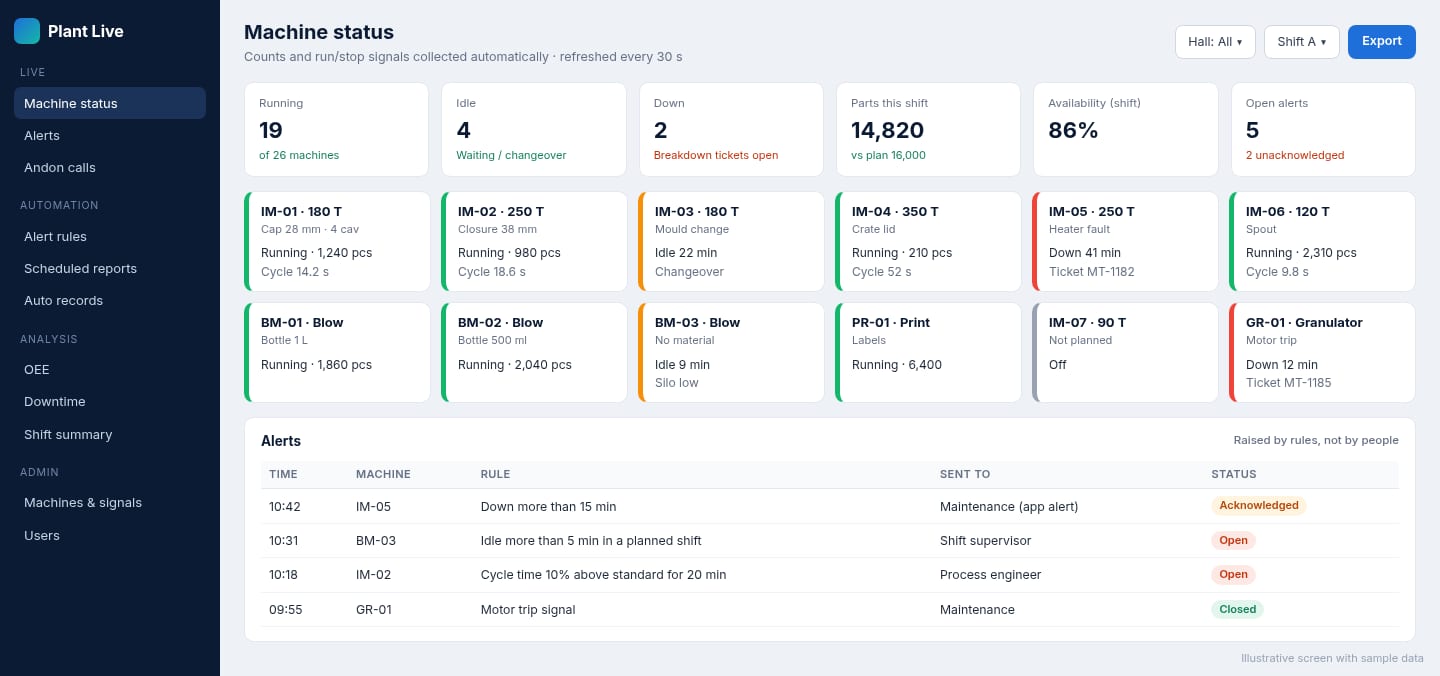
Each hall has a live board, on screens on the floor and in the office, showing every machine as a tile: the product or mould it is running, its count for the shift, current cycle time, and how long it has been idle or down. Breakdown tickets raised by maintenance appear on the same tile.
3. Alert rules instead of phone calls
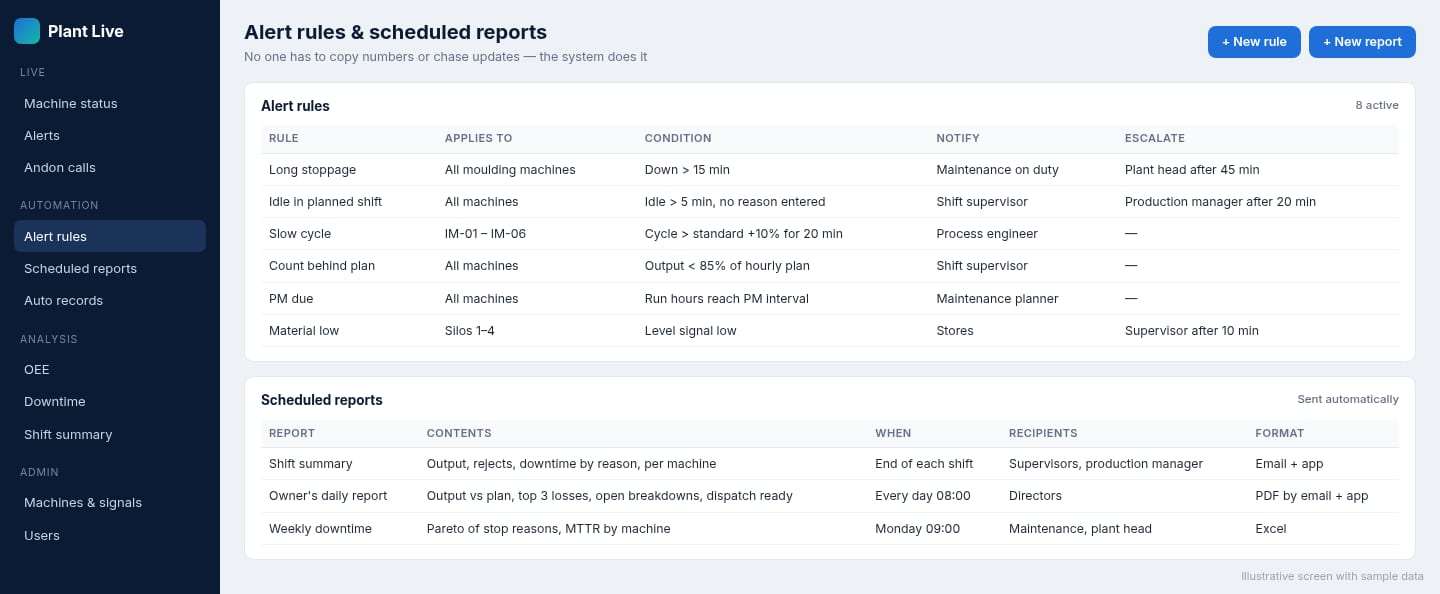
The client defined rules in plain terms, and the system watches for them continuously:
- A machine down for more than a set time alerts maintenance, then escalates to the plant head if it continues.
- A machine idle in a planned shift without a reason alerts the shift supervisor.
- A cycle time above standard for a sustained period alerts the process engineer.
- Output behind the hourly plan alerts the supervisor before the shift is lost.
- Run hours reaching a maintenance interval notify the maintenance planner.
Each alert is logged with who received it, who acknowledged it and when it was closed.
4. Reports that send themselves
Shift summaries go to supervisors at the end of every shift; the owners receive a daily report each morning with output against plan, the biggest losses and open breakdowns; maintenance gets a weekly downtime analysis. All of them are built from machine data, not from re-typed figures.
How the rollout worked
We connected a pilot group of machines first and compared the system's counts and stoppages with what the team saw on the floor. Once the numbers matched reality, the remaining machines were connected hall by hall. Alert rules were switched on gradually, starting with long stoppages, so people were not flooded with notifications before thresholds were tuned.
The results
The software was delivered and runs across the client's moulding halls. The main changes:
- No more walking the floor to know machine status; it is on screen in the hall and the office.
- Counts and stoppages recorded automatically, including the short stops and slow cycles that paper missed.
- Problems reach the right person quickly, at any hour, with escalation if they are not handled.
- Reports arrive on time without anyone preparing them, from data the team trusts.
Where to start with factory automation
See our manufacturing automation software and machine monitoring pages, or read what to automate first and connecting older machines. All custom code is transferred to you on final payment.
Frequently asked questions
Do our machines need to be new for this to work?
No. Newer machines may expose counts and status over their controller; older machines can often be connected with simple signals such as a cycle or run contact, through a small I/O device. What is possible depends on each machine, so we survey them before quoting.
What happens when a machine stops and nobody enters a reason?
The stoppage is still recorded from the machine signal. The system can prompt the operator or supervisor for a reason, and escalate if a stoppage in a planned shift stays unexplained.
Which notification channels can alerts use?
Alerts appear in the app and can be sent by email. Other channels can be added where the client has a suitable service and account; we confirm this during scoping.
Who owns the software?
The client. All custom code built for a project is transferred to the client on final payment.