The client
The client is an owner-operated trucking company in the United States running three to four trucks, with drivers on the road and the owner handling the business side: booking loads, paying drivers, tracking fuel and working out whether each truck is actually making money. The company plans to add trucks and drivers, and wanted its systems ready for that before it happened. At the client's request we do not publish its name.
The challenge: the numbers lived in too many places
Like many small fleets, the company kept its records in a mix of spreadsheets, rate confirmations, fuel receipts and notes. The work got done, but every pay period meant hours of collecting and re-typing figures:
- Load details were scattered. Rate, loaded and empty miles, pickup and delivery details, truck and driver for each load sat in different files and emails.
- Driver pay was worked out by hand. Pay depended on each driver's arrangement and the miles or revenue on each load, so every settlement had to be calculated and checked manually.
- Fuel and other expenses were hard to tie back to trucks. Without linking fuel, tolls and repairs to the right truck and trip, it was difficult to see which truck or lane was profitable.
- Reports took a long time to build. The owner reviews the business every two weeks. Producing a clear picture of gross revenue, driver pay, fuel and net for that period, or for any other date range, meant rebuilding a spreadsheet every time.
- Growth would make it worse. Every new truck and driver would add more rows, more files and more chances for mistakes.
What the owner asked for
The brief was short and specific: an automated web app to manage the trucking business that would
- let the team enter load details, with truck and driver information, rates, miles, gross revenue, driver pay and fuel expenses;
- automatically generate biweekly reports, and reports for any selected date range, with detailed earnings and expenses;
- allow them to add new trucks and drivers easily as the company grows.
What Corposol built
We built a secure, browser-based web app that the owner and office staff can use from a laptop, tablet or phone. Every load, truck, driver and expense is stored in one database, so reports are calculated from the same records that were entered day to day, not re-typed at the end of the period.
Load entry that does the arithmetic
Each load is entered once: reference number, broker or customer, truck, driver, pickup and delivery, loaded and empty miles, the line-haul rate and any extras such as fuel surcharge or detention. The app then calculates what used to be worked out by hand:
- Gross revenue for the load, from the rate and extras;
- Total miles and revenue per mile, using loaded and empty miles;
- Driver pay for the load, using the pay rule set for that driver.
Fuel purchases and trip expenses such as tolls or lumper fees can be recorded against the load and truck, so the cost side of each trip sits next to its revenue.
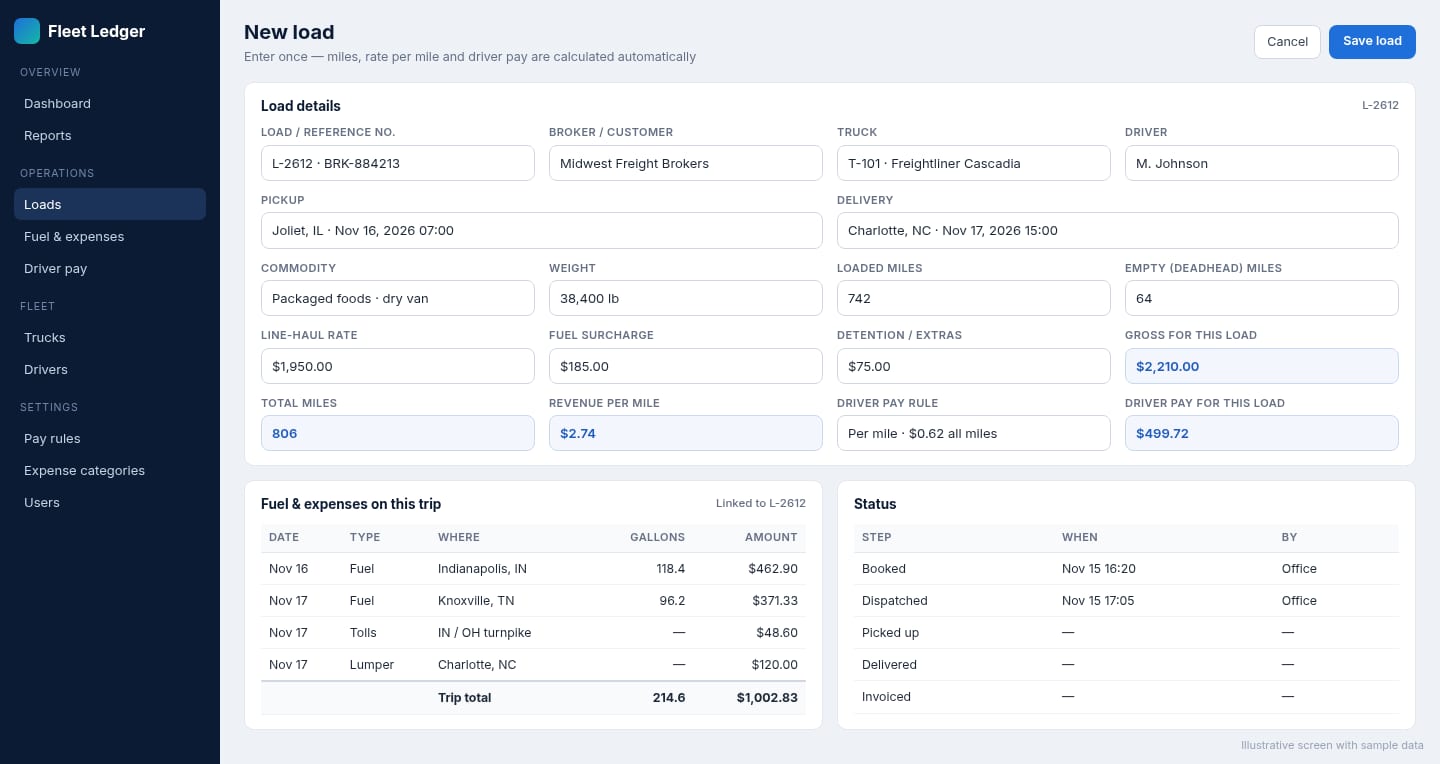
Driver pay rules, set once per driver
Small fleets often pay drivers differently: one on cents per mile, another on a percentage of the load. Instead of building those rules into a spreadsheet formula, each driver's pay rule is stored on their profile. When a load is saved, the app applies the correct rule, and the driver's earnings for any period are simply the sum of their loads. Changing a driver's rate from a given date doesn't rewrite the pay on loads already recorded.
Biweekly reports, or any date range
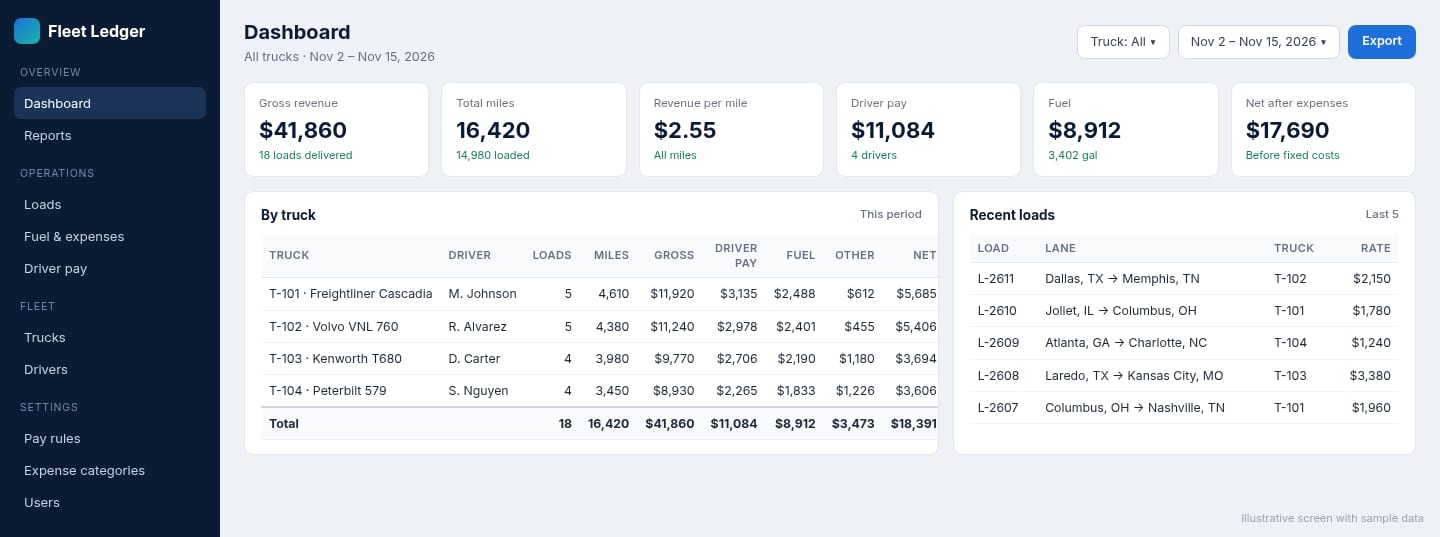
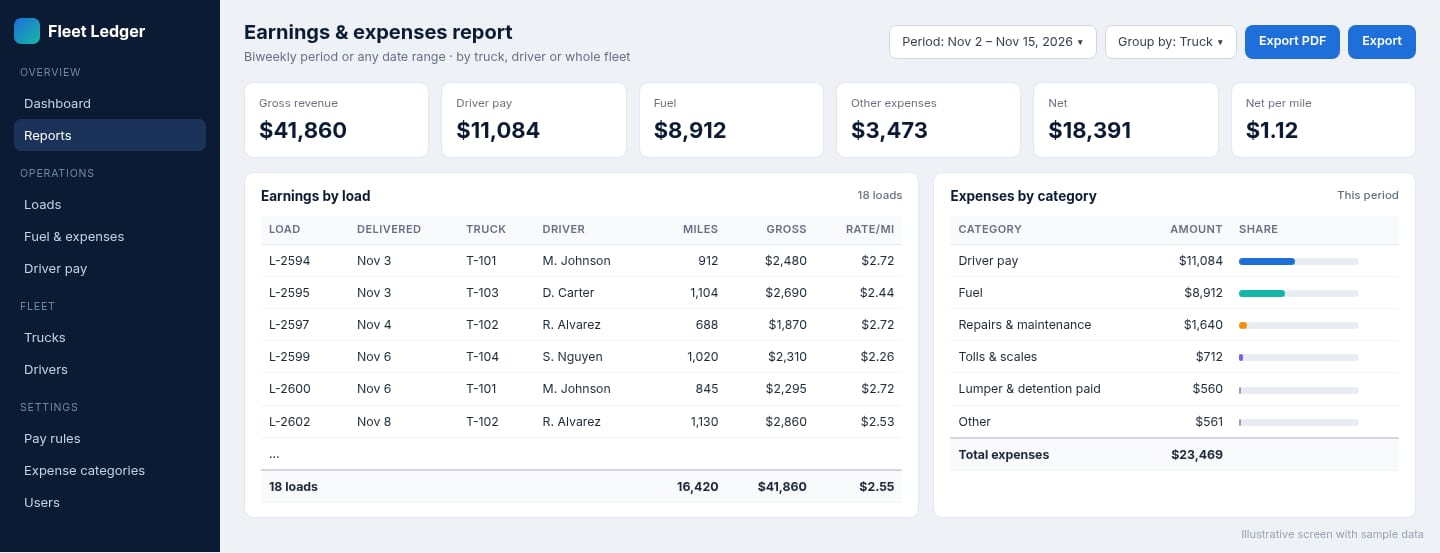
The heart of the system is reporting. The owner picks a biweekly pay period or any custom date range and the app produces a detailed earnings and expenses report:
- Earnings by load: delivered date, truck, driver, miles, gross and revenue per mile for every load in the period;
- Expenses by category: driver pay, fuel, repairs and maintenance, tolls and other costs;
- Totals and net for the whole fleet, with the option to group by truck or by driver;
- Export to PDF or Excel for the owner's records or their accountant.
Built for the next truck, and the one after
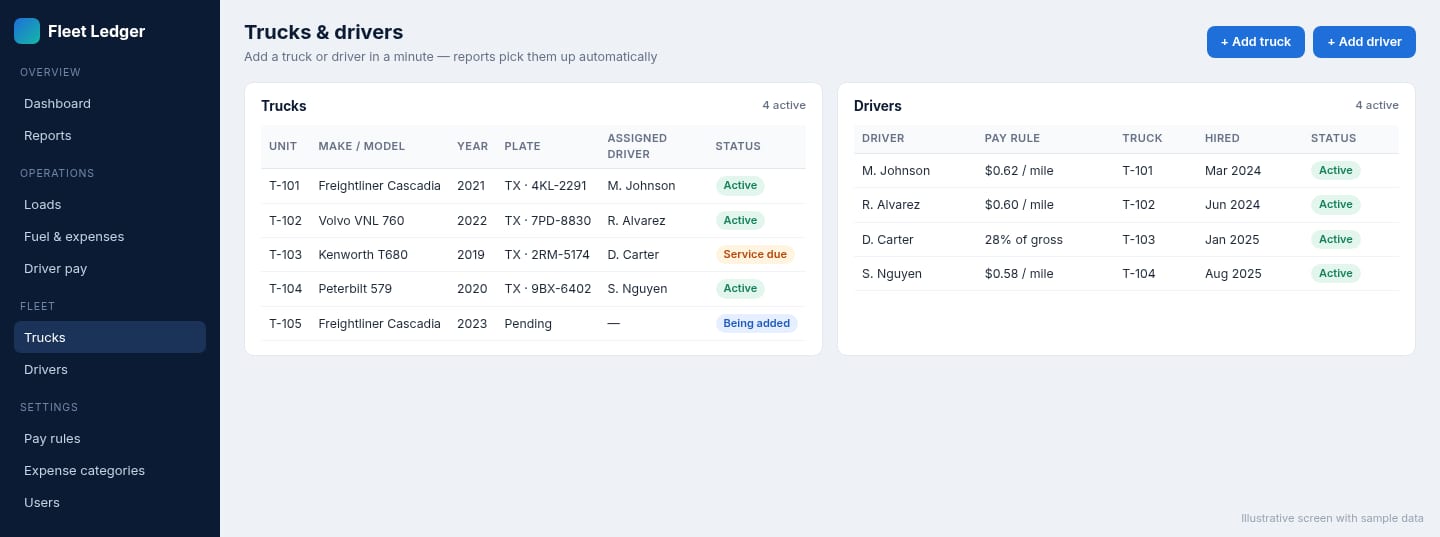
Growth was part of the brief from day one. Adding a truck or a driver takes a minute: unit number, make and model, plate and assigned driver for a truck; name, pay rule and assigned truck for a driver. New trucks and drivers appear in load entry and in every report automatically, with no spreadsheet columns to add and no formulas to copy. Trucks and drivers who leave are marked inactive, so their history stays in past reports.
The results
The web app was delivered to the client's requirements and is used to run the business side of the fleet. In day-to-day terms:
- One place for every load. Rates, miles, truck, driver and trip costs are recorded together instead of across spreadsheets and paperwork.
- Driver pay is calculated, not re-worked. Each driver's pay rule is applied automatically to every load.
- Biweekly reports in moments. The owner selects the period and gets detailed earnings and expenses, instead of rebuilding a spreadsheet.
- A clear view of each truck. Revenue, miles, fuel and other costs by truck show which units and lanes are pulling their weight.
- Ready to grow. New trucks and drivers can be added at any time without changing how the business is run.
Why a custom app made sense here
For a fleet of this size, the deciding factors were fit and ownership. The owner already knew exactly which numbers they wanted to see every two weeks and how each driver is paid; the app was built around that, not around a vendor's idea of a trucking company. Because the client owns the code, there are no per-truck or per-user fees as the fleet grows, and new features can be added when the business needs them.
Running a small fleet on spreadsheets?
Corposol builds custom web applications and business automation for owner-run businesses in the US, India and elsewhere, including truck and fleet management. Tell us how you work today and we'll show you a prototype before you commit. All custom code is transferred to you on final payment.
Frequently asked questions
Is this a load board or dispatch system?
No. This project was built to run the business side of a small fleet: recording each load, its revenue, miles and costs, paying drivers correctly and reporting earnings and expenses. Features such as dispatch or customer invoicing can be added to a custom system later if the business needs them.
Can driver pay be per mile for one driver and a percentage for another?
Yes. Each driver has their own pay rule, such as cents per mile on all miles, cents per loaded mile or a percentage of the load's gross, and the system applies the right rule to every load automatically.
Why not use an off-the-shelf trucking app?
Ready-made apps are a good fit for many fleets. This owner wanted reports laid out exactly the way they review the business every two weeks, their own expense categories and their own pay rules, without paying per truck or per user as the fleet grows. A custom web app gave them that, and they own it.
Who owns the software?
The client. All custom code built for a project is transferred to the client on final payment.