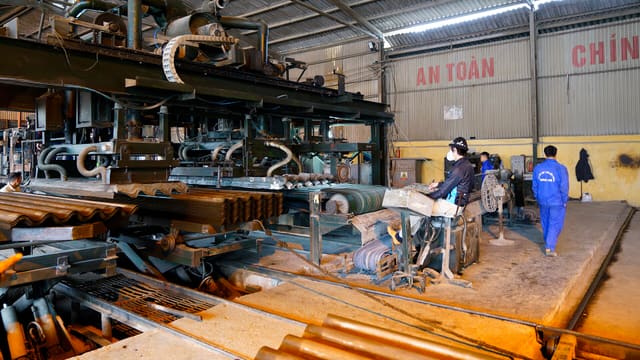
Textbooks on maintenance management describe planners, schedulers, reliability engineers and storekeepers. Most Indian SME factories have none of these. They have a maintenance head — often an experienced electrician or fitter — and two to five technicians across shifts, who also handle utilities, building repairs, new machine installation and anything else that breaks. There is no time for planning in the textbook sense, and the paperwork is a breakdown register filled in when someone remembers.
This guide describes a practical maintenance system for exactly this situation: small team, no planner, constant firefighting. It focuses on the few routines and records that give the most benefit for the least time, and on how simple maintenance software can carry the administrative load instead of a planner.
The reality of small maintenance teams
- Breakdowns come first. When a machine stops, everything else waits. Preventive work happens in whatever time is left, which is often none.
- Knowledge is in people. The maintenance head knows which motor has been rewound twice and which gearbox makes a noise before it fails. When they are on leave, the team struggles.
- Spares are found when needed. Or not found, and bought urgently at a premium, while the machine waits.
- Nobody measures. How many breakdowns, how long, which machines, what cost — nobody knows, so there is no case for investment or change.
- Production sees maintenance as a cost. And maintenance sees production as the reason machines are never stopped for servicing.
The aim is not to turn this team into a planning department. It is to make their work visible, protect a small amount of time for prevention, and capture knowledge so it stops depending on one person.
Four records that matter
A small team should keep only the records that pay back. Four are enough:
- Machine register — every machine and utility with a number, location, make, model, criticality and a QR tag.
- Breakdown work orders — machine, problem reported, time reported, cause found, action taken, spares used, time restored, technician.
- Preventive tasks — for critical machines only at first: task, frequency (by date or running hours) and a short checklist.
- Critical spares — the parts whose absence would stop a critical machine for days, with stock and minimum level.
Everything else — detailed planning, labour hour budgets, reliability analysis — can come later, if ever.
The software does the planner's admin
In a large plant, a planner's job is largely administrative: logging requests, assigning jobs, tracking what is overdue, checking spares, compiling reports. Lightweight software can do most of that automatically:
- Operators report breakdowns by scanning the machine's QR code — no phone calls, no searching for a technician. See our guide to fast breakdown reporting.
- The request appears on every technician's phone, with the machine's recent history.
- Preventive tasks become due automatically by date or running hours, and appear in the same list.
- Spares used on a job are deducted from stock, and a reorder alert is raised for critical spares.
- Weekly reports — breakdowns, downtime, PM done versus due, repeat failures — are generated without anyone compiling them.
The maintenance head keeps the decisions: which job first, who does it, what to postpone. The software keeps the lists.
A daily routine that fits
Start of shift: ten minutes
The maintenance head looks at one screen: open breakdowns, PM due today and overdue, and any machine stopped right now. They assign the day's preventive tasks to technicians — usually one or two short tasks per person — and agree with the production supervisor when each machine can be stopped.
During the shift
Breakdowns are attended as they come. Technicians close each job on their phone with cause, action, spares and time. Preventive tasks are done in the agreed windows, with the checklist completed on the phone and any abnormality raised as a follow-up job.
End of shift: five minutes
Open jobs are handed over to the next shift with a note. The software shows the outgoing technician's open jobs, so nothing is forgotten.
Weekly: thirty minutes
The maintenance head and the production manager look at the weekly report: breakdowns by machine, repeat failures, PM done versus due, spares bought urgently. They choose one or two problems to fix permanently.
Preventive maintenance: start small
A common mistake is to write PM plans for every machine from the manufacturers' manuals on day one. The result is a list of hundreds of tasks the team can't possibly do, which is ignored within weeks. Instead:
- Pick the critical machines — bottlenecks, machines with no backup, utilities like compressors and DG sets that stop everything.
- Use breakdown history to choose tasks that prevent the failures that actually happen.
- Keep each task short — fifteen to thirty minutes where possible, so it fits in a break or changeover.
- Use running hours for machines whose use varies, so PM follows wear rather than the calendar.
- Add machines gradually as the team proves it can keep up.
Daily operator checks — cleaning, lubrication levels, air pressure, unusual noise — can be done by operators with a short checklist on the shop-floor tablet, freeing technicians for skilled work. This is the first step of autonomous maintenance in TPM.
Getting production's cooperation
PM gets skipped because production won't release the machine. Three things help:
- Agree windows in advance. PM due next week is visible to the planner, who builds it into the schedule — a changeover, a break, a planned stop.
- Show the cost of skipping. When breakdown history shows a machine stopped for twelve hours because a ten-minute check was skipped, the conversation changes.
- Report both sides. PM compliance and breakdown hours in the owner's weekly report make maintenance a shared responsibility rather than a maintenance department problem.
Spares without a storekeeper
Small teams usually keep spares in a maintenance store or cupboard that they manage themselves. Keep it simple:
- List the critical spares for critical machines — bearings, belts, contactors, sensors, seals, specific motors — with the machines they fit.
- Set a minimum quantity for each.
- Record spares issued on each work order, from the phone.
- Review the reorder list weekly.
Non-critical spares can be bought when needed. Our guide to spare parts criticality explains how to decide which spares deserve stock.
Outside help
Small teams rely on outside help: machine makers' service engineers, AMC vendors for compressors, DG sets and air conditioning, motor rewinders, hydraulic specialists, electricians for HT work. Record their visits on work orders like internal jobs — who came, what they did, what it cost — and track AMC contracts with their renewal dates. Over time, this shows which vendors fix problems and which return repeatedly for the same fault.
Capturing the maintenance head's knowledge
The most valuable maintenance knowledge in many factories exists only in one person's head. Every closed work order with a real cause and action — not just "repaired" — captures a piece of it. Notes on each machine's history card — "gearbox oil seal leaks when oil level is overfilled", "use only this make of proximity sensor" — capture more. Photos of wiring, settings and assemblies taken during repairs are invaluable the next time. None of this needs extra meetings; it needs the habit of writing one useful line when closing each job.
What to measure
- Breakdown hours by machine, weekly — the headline number.
- Number of breakdowns and repeat failures (same machine, same cause, within a month).
- Mean time to repair — how long machines are down per breakdown. See how to calculate MTTR and MTBF.
- PM compliance — tasks done on time versus due.
- Urgent spare purchases — a sign of missing critical spares.
Five numbers, reviewed weekly, are enough to steer a small team.
Utilities: the machines nobody owns
Compressors, DG sets, transformers and panels, cooling towers, chillers, water pumps and lighting are maintained by the same small team, often only when they fail. Yet a compressor failure stops every pneumatic machine in the plant, and a DG set that won't start during a power cut stops everything. Register utilities exactly like production machines, give the critical ones short preventive tasks and running-hour logs, and record their breakdowns. Many statutory and safety inspections also apply to utilities — boilers, pressure vessels, lifting equipment, electrical installations — and tracking their due dates in the same system prevents lapses.
Shift coverage and on-call
With a small team spread across shifts, one technician may be alone at night. Two practices help. First, a clear on-call arrangement for problems the night technician can't handle, with the maintenance head or a senior technician reachable by phone. Second, a handover list of open jobs and watch points from the day shift, visible on the night technician's phone. The software can show which technician is on duty and route requests accordingly, and escalation to the on-call person happens automatically when a critical machine stays down beyond a set time.
When to add a planner
As a factory grows, there comes a point where the maintenance head spends most of the day on administration — assigning jobs, chasing spares, compiling reports — and little on technical work. That is the signal to consider a dedicated planner or coordinator. Software delays that point considerably by doing the routine administration automatically, but it doesn't remove it entirely. When the weekly review regularly runs out of time, or PM compliance falls despite effort, a planner is likely to pay for themselves.
A worked example
An engineering plant with 60 machines had a maintenance team of a supervisor and four technicians across two shifts. Breakdowns were called in by phone, recorded in a register at the end of the day if at all, and PM existed as a wall chart that had not been updated for months.
The team tagged machines with QR codes, started recording every breakdown on phones, and listed critical spares for the twelve most important machines. After ten weeks, the history showed that three machines accounted for nearly half of breakdown hours, and that one hydraulic press had the same seal failure repeatedly. Short PM tasks were written for those three machines and agreed with production as part of the weekly changeover. The press's seal problem was traced to a contaminated oil supply. Breakdown hours fell, and when the supervisor went on two weeks' leave, the team could see each machine's history on their phones instead of calling him.
Getting started this month
- Number and QR-tag every machine and utility.
- Record every breakdown on phones, with cause and action.
- List critical spares for your most important machines.
- After two months, write short PM tasks for the machines the history points to.
Working with Corposol
Corposol builds simple, custom maintenance software for small factory teams — QR breakdown reporting, technician phone apps, preventive maintenance and spares — as part of our manufacturing software work. Read our use case for an engineering plant. All custom code is transferred to you on final payment.
Frequently asked questions
Can a maintenance team of three or four use a CMMS?
Yes, if the system is kept simple: a breakdown list, a preventive maintenance due list, machine history and spares. Small teams benefit most because they have the least time for paperwork and the most to lose when knowledge sits with one person.
How much time does a small team spend on records?
With phone-based work orders and short checklists, a few minutes per job. Closing a breakdown — what was wrong, what was done, spares used — takes about the same time as writing it in a register, and it is then available to everyone.
What should a small team do first?
Record every breakdown with the machine, problem, cause, action and time. After two or three months, the history shows which machines and failures deserve preventive maintenance first.
How do we stop preventive maintenance being skipped?
Agree PM windows with production in advance, show PM due alongside the production plan, keep tasks short, and report PM done versus due every week to the owner.