The client
The client is an auto component supplier in India making machined and pressed parts for vehicle and equipment manufacturers. Raw materials such as steel bar, sheet and castings come from several suppliers, and some operations, like plating, are done by job-work vendors. Its customers expect consistent quality and quick, documented answers when something goes wrong. At the client's request we do not publish its name.
The challenge: stores and quality didn't share the same truth
- Two registers, two versions of the stock. Stores recorded what was received and issued; quality recorded what was inspected. Nothing stopped material from being issued before inspection.
- Lots and heat numbers were hard to follow. Once material went to production, linking a finished part back to its raw material lot took a lot of digging.
- Rejections didn't reach suppliers properly. NCRs were written, but supplier performance over time was not visible.
- Stock didn't match the books. Without locations and regular counts, physical stock and system stock drifted apart.
- Customer complaints took days to investigate, because the trail ran through several files and registers.
What we implemented
We built one system for stores and quality, so that the status of every lot, where it is, how much there is and whether quality has accepted it, is a single record everyone sees.
1. Goods receipt by lot
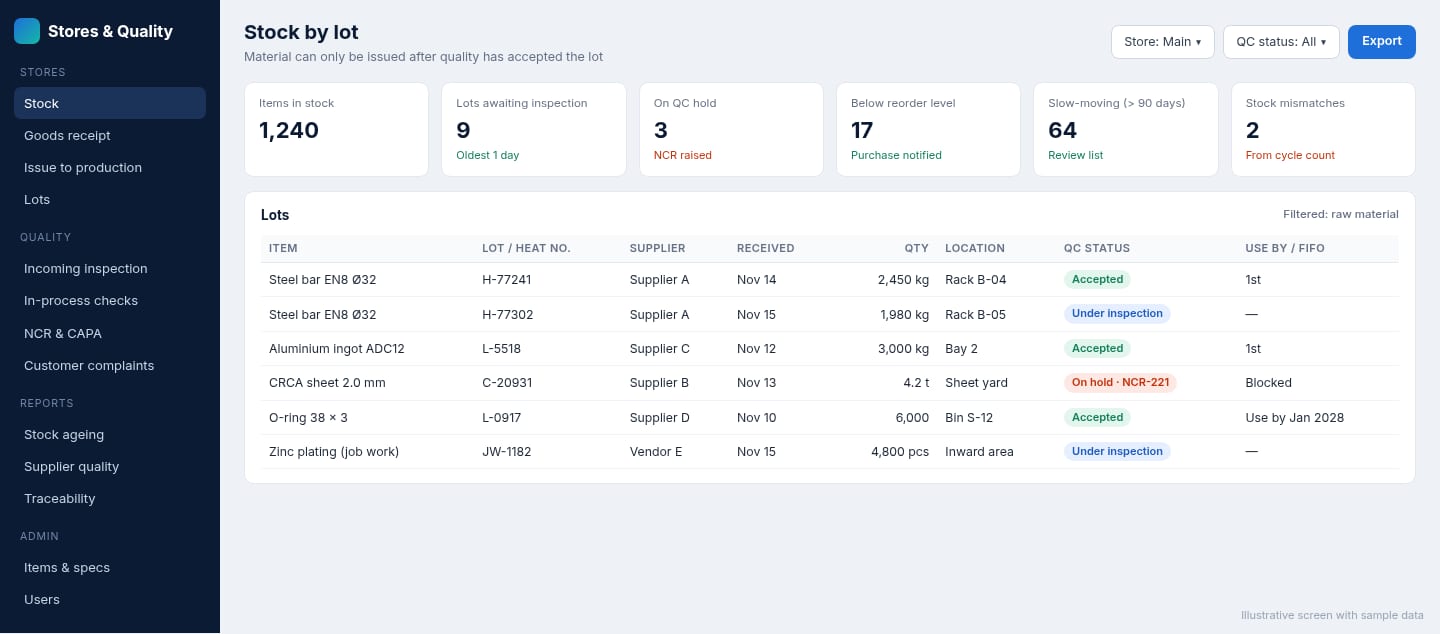
Every receipt is recorded with its supplier, lot or heat number, quantity and location, and labelled. Material from job-work vendors is received the same way against the outward challan. New lots start in Under inspection status.
2. Incoming inspection against specifications
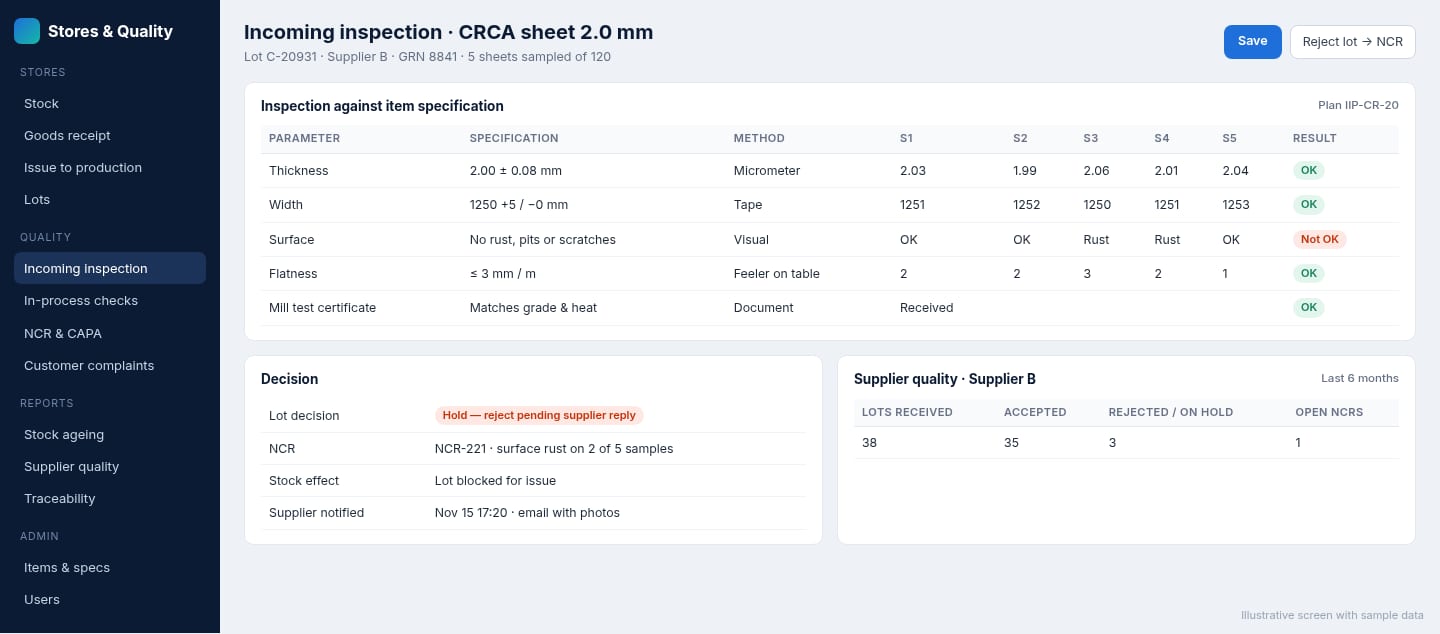
Each item has an inspection plan: the parameters to check, the specification and tolerance for each, the method and the number of samples. Inspectors enter readings for each sample, and the system marks each parameter OK or not OK against the specification. Certificates such as mill test certificates are checked and attached to the lot.
3. QC status that controls stock
Only lots that quality has accepted can be issued to production. Lots under inspection wait; lots that fail are put on hold and blocked. Stores can see the status on the stock screen and in the issue screen, so there is no need to check with quality by phone.
4. NCRs and supplier quality
A failed inspection raises a non-conformance report linked to the lot, with photos and the readings that failed. The supplier is notified, and the NCR is tracked to closure. Over time each supplier gets a quality record: lots received, accepted and rejected, and open NCRs.
5. Issue against work orders, FIFO and traceability
Material is issued to work orders by lot, with the oldest accepted lot suggested first. Because every finished batch carries its work order, the system can trace from a raw material lot to the parts and dispatches it went into, or backwards from a customer complaint to the material and supplier.
6. Stock you can trust
Locations, cycle counts and stock-ageing reports keep physical and system stock in line, and items below their reorder level are flagged for purchase.
How the rollout worked
We started with item masters, locations and opening stock by lot for the main raw materials, then went live with goods receipt and the QC hold, which delivered the most important control first. Inspection plans were added item by item, starting with materials that had caused problems before. Traceability and supplier quality reports came last, once enough lots had moved through the new process.
The results
The software was delivered and is used by stores, quality and production planning. The main changes:
- Uninspected or rejected material can't be issued, because stock status and quality status are the same record.
- Every lot is traceable, from receipt to production to dispatch.
- Suppliers get clear, documented feedback, and the company can see which suppliers perform consistently.
- Stock figures the team trusts, by lot and location.
- Customer complaints are investigated from one system rather than many files.
Connecting inventory and quality in your factory?
See our inventory management, quality management (QMS) and traceability pages, or read incoming inspection and AQL sampling. All custom code is transferred to you on final payment.
Frequently asked questions
Why connect inventory and quality in one system?
Because the most common quality escape is material that was used before it was inspected or after it was rejected. When stock status and inspection status are the same record, the system can stop that from happening instead of relying on people to check two registers.
Can we trace a finished part back to the raw material lot?
Yes. Lots are recorded at goods receipt and issued to work orders, and finished goods carry the work order reference, so a lot can be traced forwards to parts and customers or backwards from a complaint to the material.
Does this make us compliant with IATF 16949 or other standards?
Software doesn't make a company compliant on its own. It keeps the inspection, NCR and traceability records that customers and auditors usually ask to see, in an organised and searchable way. The quality system itself remains the company's responsibility.
Who owns the software?
The client. All custom code built for a project is transferred to the client on final payment.