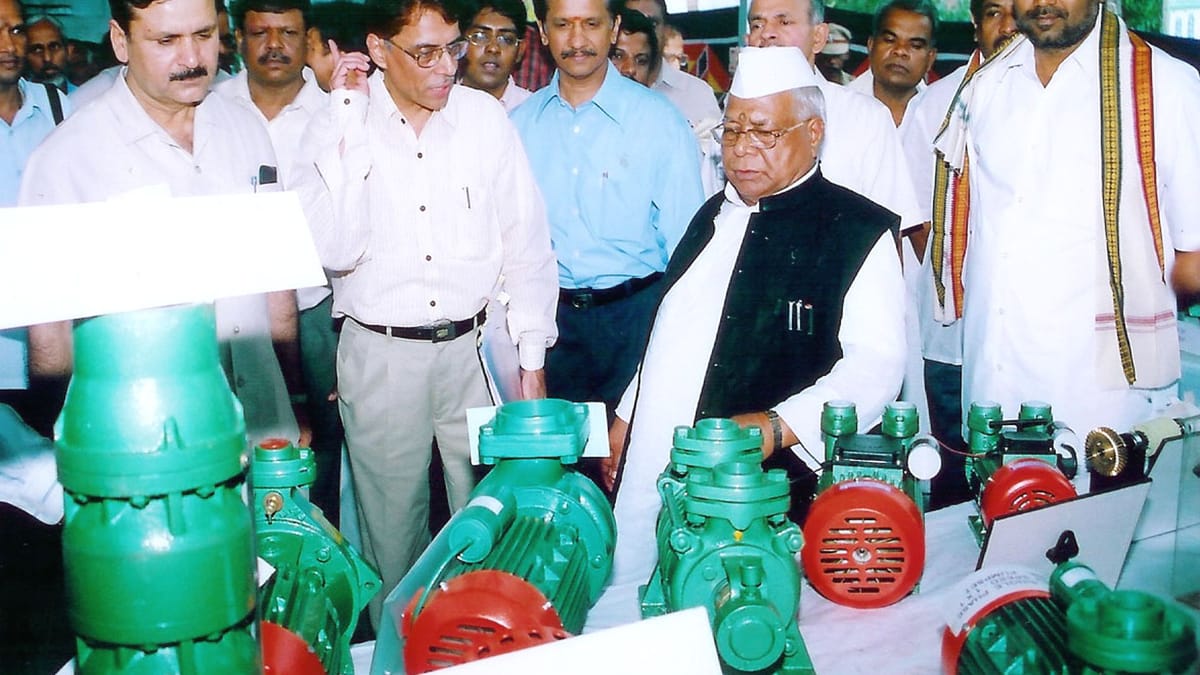
Coimbatore has long been known as India's pump city. Its small and mid-sized engineering units make agricultural pumps, domestic monoblocks, submersible pumps and motors, and the castings, stampings and machined parts that go into them. Estimates of the city's share of India's pump output vary — industry bodies have cited figures from around a third to over half — and recent reporting describes a tougher market, with competition from Gujarat clusters such as Ahmedabad and Rajkot, raw material price swings and pressure on smaller units. In that environment, cost control, consistent quality and fast service to dealers decide who grows.
Many pump and motor makers still manage production with registers, Tally and spreadsheets. This guide explains what software a pump or motor manufacturer needs, what to digitise first, and how it helps with the specific challenges of the industry. It applies equally to pump and motor makers in Ahmedabad, Rajkot, Kolhapur and elsewhere.
The typical flow in a pump and motor factory
- Sales and dealer orders — orders from dealers, distributors, government schemes and OEM customers.
- Purchase and stores — castings, stampings, copper winding wire, bearings, shafts, cables, capacitors, packing materials.
- Job work — castings from foundries, machining, painting or plating by outside vendors.
- Machining and sub-assemblies — shafts, impellers, casings and motor bodies.
- Motor winding — stator winding, varnishing and testing.
- Assembly — motor and pump assembly, stage assembly for submersibles.
- Testing — performance and electrical tests on the test bench.
- Painting, packing and dispatch — with serial-number labels and warranty cards.
- Warranty and service — complaints, repairs and replacements through dealers.
Managing hundreds of variants
A pump maker's catalogue often runs into hundreds of models: different motor ratings, number of stages, impeller types, pipe sizes, voltages, single or three phase, cable lengths and packaging for different markets. Keeping a separate bill of materials for each model is error-prone and hard to update.
A configurable BOM builds each model from rules and common modules — for example, motor rating determines stator, rotor, winding wire and bearings; stage count determines impellers, diffusers and shaft length; voltage determines winding data and capacitor. When a component changes, it is updated once and every affected model follows. Material requirements, costing and production instructions all come from the same structure.
Purchase, stores and copper
Copper winding wire is one of the largest and most volatile costs in motor manufacturing, and it is easy to lose track of. A stores module should record:
- Receipts by supplier, grade and gauge, with weights.
- Issue to winding by job, with standard versus actual consumption per motor rating.
- Scrap copper returned and sold.
Comparing actual copper use per motor with the standard quickly shows if winding practices, wire gauges or scrap handling need attention. The same approach applies to castings, bearings and other high-value items. Reorder levels and supplier lead times help keep production from stopping for a missing part.
Job work with foundries and machinists
Most pump makers rely on outside vendors for castings, machining, and sometimes painting or plating. A job work module records material sent to each vendor, parts received back, rejections at incoming inspection, and pending balances. It answers questions that otherwise take phone calls and register searches: how many casings are with which machinist, what is overdue, and which vendor has the highest rejection rate.
Winding and assembly tracking
On the shop floor, simple job tracking makes a big difference. Production orders are released for each model and quantity; winding, assembly and testing record completed quantities against each order, and every finished pump or motor gets a serial number. Supervisors see work in progress by stage, and planners see which orders are on track for dispatch.
For motors, winding records can include winding data, wire gauge and turns, varnish batch, and insulation and resistance test results after winding. These details become valuable when analysing warranty failures.
Performance and electrical testing
Every pump should be tested before dispatch, and many customers — especially government schemes and OEMs — require test records. Typical tests include performance at several points on the curve (head, discharge, input power, current, efficiency) and electrical safety checks such as insulation resistance and high-voltage tests.
Software can show the test points and acceptance limits for each model, record results on a tablet at the test bench or import them from test equipment where it provides data, flag failures automatically, and store results against the serial number. Test certificates can be printed or shared from the same record. Over time, the data shows which models, batches or component suppliers have more test failures.
Dispatch, dealers and the dealer app
Most pump makers sell through dealers and distributors. A sales order module with a dealer portal or app lets dealers:
- Place orders from the current product list and price list.
- See order status and dispatch details.
- Check outstanding amounts and credit limits.
- Register sold pumps with customer details, which starts the warranty.
- Raise warranty and service complaints with photos.
The factory sees demand by model and region, plans production accordingly, and spends less time on phone calls and WhatsApp messages about order status.
Warranty and service
Warranty costs can quietly eat into margins. When every pump has a serial number linked to its production date, winding and test records and component batches, warranty claims can be analysed properly:
- Which models, production months or component suppliers have the most failures?
- Are failures concentrated in particular regions, suggesting installation or power supply issues?
- Is the claimed pump actually within its warranty period, and was it sold through the dealer claiming it?
Replacement parts and repairs can be tracked through to closure, and the data fed back to design and purchasing.
A worked example: a spike in motor failures
A Coimbatore submersible pump maker sees warranty complaints rise from one district during the summer. Without data, the team assumes poor installation and argues with the dealer.
With serial-number records, the service manager finds that most of the failed motors were wound in the same two weeks in March and used winding wire from one supplier batch, while their test results were within limits but near the edge for current. The supplier batch is quarantined, remaining stock is tested, and the winding standard is reviewed. The dealer relationship is preserved, and the problem is solved at its source rather than argued about.
Costing and pricing
Raw material prices — copper, steel, castings — change often, and pump makers must reprice regularly. With BOMs, actual consumption, labour, job work costs and overheads recorded, the system can calculate the current cost of each model and show the effect of a copper price change across the range in minutes. Sales teams can quote with confidence, and management can see which models and customer segments really contribute to profit. See production costing software.
Working with existing accounting software
Most pump and motor makers in Coimbatore use Tally or a similar accounting package, and there is usually no reason to replace it. The manufacturing system handles BOMs, production, testing, stores, job work, dealers and warranty, and shares data such as sales invoices or purchase entries with the accounting system where it provides an import facility, export or API. We confirm what is feasible during scoping.
Government schemes and tenders
Many agricultural pump makers supply under government programmes such as solar pump schemes, which typically involve specifications, inspections, documentation and installation records. Software can keep test records, serial numbers, dispatch details and installation information in one place, making it easier to produce the documentation these programmes request. The requirements of each scheme differ, and meeting them depends on the product and the process; the software helps keep the records complete and easy to find.
Small manufacturers and phased budgets
Many Coimbatore pump and motor makers are small family businesses with a few dozen employees. They do not need, and cannot justify, a large ERP project. A phased custom system works better: start with the area that causes the most daily pain — often stores and job work, or dealer orders — and add production tracking, testing and warranty as the first phase proves its value. Simple screens on low-cost Android tablets and phones keep hardware costs down, and a cloud system avoids the need for a server room and in-house IT staff.
Spares and service parts
Pump users need spares quickly — impellers, mechanical seals, bearings, capacitors, cables — and spares are often a profitable part of the business. Keeping spare part numbers linked to the models and serial ranges they fit lets dealers and service staff order the right part the first time. Spares stock, orders and dispatches can be managed in the same system as production, with separate pricing and dealer discounts, so the factory knows what is selling and keeps the right parts in stock.
Plant dashboards for owners
Owners of small and mid-sized pump companies are usually involved in everything, from purchase approvals to dealer calls. A simple owner dashboard on the phone — today's production and testing by model, dispatches, dealer orders pending, outstanding amounts, copper stock and price, test failures and open warranty complaints — saves hours of calls each week and makes it easier to delegate day-to-day decisions to supervisors with confidence.
Exports
Several Coimbatore manufacturers export pumps and motors to Africa, the Middle East and Southeast Asia. Export orders bring their own requirements: different voltages and frequencies, specific labelling and packaging, test certificates for each unit and documents for shipping. A system that already holds variant BOMs, serial numbers and test records can produce export documentation with little additional effort, and buyers gain confidence when every unit has a traceable test record.
Energy-efficiency labelling and records
Many pump and motor models are sold with energy-efficiency ratings or labels, which depend on consistent performance. Storing performance test results by serial number and model makes it straightforward to check, batch by batch, that production matches the declared performance, and to spot drift early.
What to digitise first
- Configurable BOMs for the product range.
- Stores, purchase and job work — especially copper and castings.
- Production orders, winding and assembly tracking with serial numbers.
- Testing records at the test bench.
- Dealer orders, dispatch and warranty.
Questions to ask a software partner
- How will our model range and variants be structured in the BOM?
- Can test results be imported from our test benches, or entered on tablets?
- Can dealers use a mobile app for orders and warranty registration?
- How will job work with foundries and machinists be tracked?
- Can the system share data with Tally?
- Who owns the code and the data?
Working with Corposol
Corposol is a Bengaluru-based company that builds custom manufacturing software for Indian manufacturers — BOMs, production tracking, testing and quality records, dealer apps and warranty systems — designed around how your factory works. Read our use case for a Peenya hydraulic equipment manufacturer whose software includes unit testing and QA. All custom code is transferred to you on final payment.
Frequently asked questions
What does software for a pump manufacturer cover?
Typically product variants and BOMs, purchase and stores, job work for castings and machining, production orders, motor winding and assembly tracking, performance and electrical testing with records per serial number, dispatch to dealers, and warranty and service records.
Can it record pump test results?
Yes. Test readings — for example head, discharge, current, voltage, power and efficiency at test points, and electrical safety tests — can be entered on a tablet or imported from test bench equipment where it provides data, and stored against the pump's serial number.
Can dealers place orders and check stock?
Yes. A dealer portal or mobile app can let dealers place orders, see dispatch status and outstanding amounts, and register warranty claims, while the factory controls pricing and credit limits.
We have hundreds of models. Can the BOM handle that?
Yes. A configurable BOM can build each model from common components — motor rating, stages, impeller, casing, cable length, voltage — instead of keeping hundreds of separate BOMs that are hard to maintain.
We outsource castings and machining. Can that be tracked?
Yes. Material sent to job workers and parts received back can be tracked by vendor, with quantities, rejections and pending balances.