Rajkot in Gujarat is one of India's best-known engineering clusters. Its industrial estates are home to foundries, forging units and thousands of machine shops, along with makers of diesel engines, pumps and motors, auto and tractor parts, bearings, machine tools, kitchen equipment and hardware. Many businesses are family-owned and have grown from a single workshop into multi-unit operations, and much of the work moves between units: a casting from one foundry, machined in another shop, assembled by the company that sells the product.
That mix — foundry, machining and assembly, with job work between them — calls for software that handles more than a typical ERP's view of manufacturing. This guide explains what software a Rajkot engineering business needs, depending on what it makes, and how to introduce it in phases.
Three kinds of Rajkot businesses
- Foundries — grey iron, SG iron and non-ferrous castings for pumps, engines, valves, auto and tractor parts, machine tools and general engineering.
- Machine shops and component makers — machining castings, forgings and bar into components for OEMs and product companies, often as job work.
- Product companies — engines, pumps, motors, machine tools and equipment sold under their own brand, often through dealers, with spares and service.
Many businesses combine two or all three. The software should fit the combination you actually run.
For foundries: melts, castings and yield
A foundry's economics are driven by metal yield and rejections. The key records are:
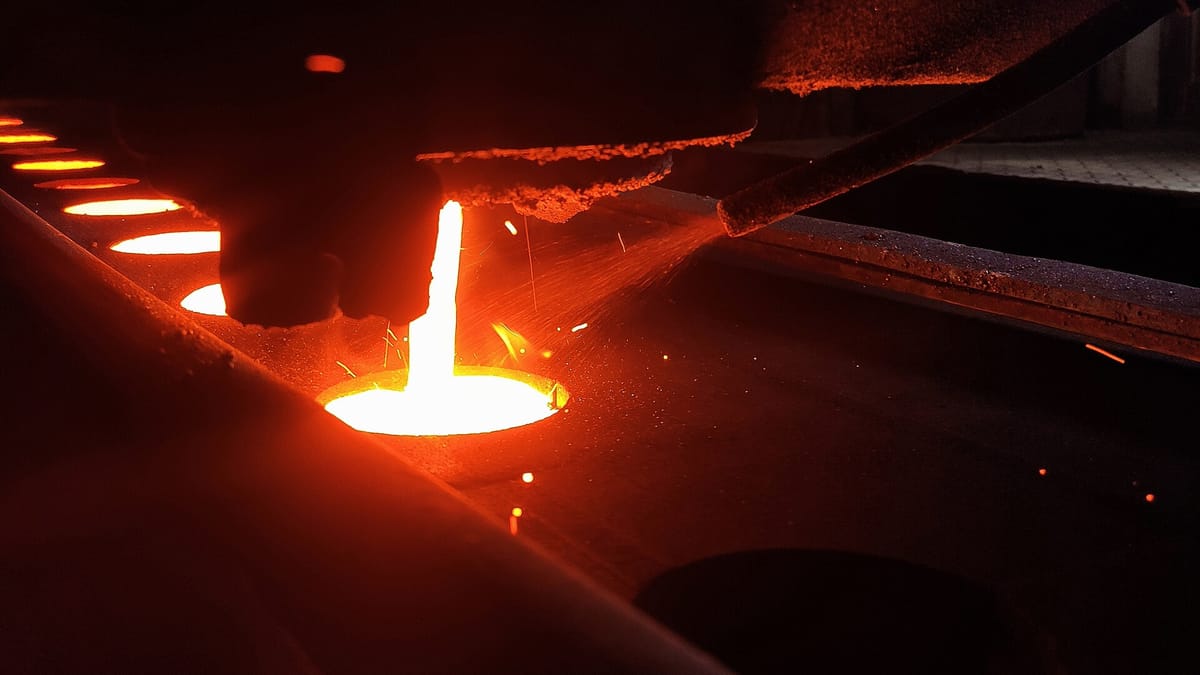
- Charge and melt — charge materials (pig iron, steel scrap, returns, ferro-alloys) by weight per heat, furnace, power or fuel used.
- Chemistry — spectrometer results per heat, against the grade specification, with corrections.
- Moulding and pouring — moulds made per pattern, poured per heat, pouring temperature where recorded.
- Knockout and fettling — good castings counted, runners and risers returned as returns.
- Inspection and rejections — by defect: blowholes, sand inclusion, shrinkage, cold shut, mismatch, dimensional — and by pattern, heat and moulding line.
From these, the foundry can calculate yield (good casting weight divided by metal poured), rejection rate by pattern and defect, and power or fuel per tonne of good castings. These numbers point directly to the patterns, methods and practices that need attention. Linking each casting to its heat, through a heat number cast or marked on the part, also gives traceability that pump, valve and auto customers increasingly expect. Our guide to heat number traceability describes the approach for steel; the same principle applies to castings.
Patterns and core boxes
Patterns are a foundry's tools. Many belong to customers. A pattern register with owner, part, number of cavities, condition, location and repair history — and the number of moulds made from each — prevents lost patterns and supports conversations with customers about repairs and replacements. Our guide to connecting production and tool management explains how usage can be counted from production records.
For machine shops: castings in, components out
Machining businesses in Rajkot often receive castings or forgings — their own, bought, or supplied by the customer — and machine them on CNC and conventional machines. Key needs include:
- Receiving castings with count, weight, heat number and incoming inspection; foundry rejections found during machining recorded and debited back.
- Customer-supplied material kept separate and reconciled.
- Job cards and routings with drawing revisions, operations and inspection.
- Production booking by machine and operator, with rejections split between machining defects and casting defects.
- Job work for operations done at other shops.
Separating casting defects found at machining from machining defects is important: casting defects are usually the foundry's responsibility and should be claimed, while machining defects are the shop's own cost. Without that split, the shop often absorbs costs that are not its own. See our guide to ERP for make-to-order job shops.
For product companies: assembly, testing, dealers and spares
Companies making engines, pumps, motors and machines under their own brand need:
- Configurable BOMs for models and variants.
- Assembly and testing records by serial number — for engines and pumps, performance test results at the test bench.
- Dealer orders and dispatch, with schemes and credit limits.
- Warranty registration and claims linked to serial numbers.
- Spares sales, often a significant and profitable part of the business.
Our guide to software for pump and motor manufacturers covers the product side in more detail; much of it applies equally to Rajkot's engine and pump makers.
Job work across the cluster
Rajkot's strength is its network of specialised units. Castings go out for fettling or shot blasting, components go out for heat treatment, grinding, gear cutting or plating, and sub-assemblies may be done by smaller units. Each movement is a job-work challan, with count and weight, and each unit has a balance. Tracking these by part, unit and age — and building realistic unit lead times into delivery planning — prevents the most common source of delays and losses. See planning around job-work vendors.
Costing by weight and by operation
Castings are typically priced per kilogram, varying with grade, complexity and order size, while machined components are priced per piece. Costing must handle both: metal cost per kilogram of good castings (including melting losses, returns and rejections), plus moulding, core making and fettling, and for machined parts, machine hours per operation at realistic rates. Knowing the real cost of each casting and component by customer is usually the most valuable outcome of good records — many businesses find that some long-standing parts are made at a loss.
Energy
Melting is energy-intensive, and power is one of a foundry's largest costs. Recording units consumed per heat, or reading from furnace meters where possible, gives energy per tonne melted and per tonne of good castings. Comparing heats, shifts and furnaces shows where practice affects energy use — for example, holding times or charge preparation. See our guide to factory energy monitoring.
Sand, cores and consumables
Moulding sand properties — moisture, compactability, permeability, green strength — and core quality strongly influence casting defects. Recording sand test results by shift and linking them to the moulds made in that period gives the foundry a way to connect defects such as sand inclusions or blowholes to sand condition. Consumption of bentonite, coal dust, resins, binders and ferro-alloys per tonne of good castings is another cost worth tracking, because small changes in practice can make a noticeable difference to cost per kilogram.
Customer schedules and spares demand
Foundries and machine shops supplying pump, engine and tractor makers often receive monthly schedules that change during the month, while product companies face seasonal demand — pumps before the agricultural season, for example. Planning moulding and machining against changing schedules, while keeping enough castings in stock for spares demand, is a constant balancing act. A view of schedules, castings in stock by stage (as-cast, fettled, machined) and planned melts helps plan capacity a few weeks ahead rather than day by day.
Multi-unit family businesses
Many Rajkot businesses have grown into several units — a foundry, a machine shop and an assembly unit, sometimes registered as separate companies in different estates. Material and parts move between them constantly, often as job work or inter-company sales with their own documents. One system that covers all units, with each unit's stock, production and documents kept separate but visible to the owners in one view, removes the need to reconcile separate registers every month. It also lets the group see the cost and margin of a product across all the units that contribute to it.
Pattern and casting development
New castings go through development: pattern making, sample castings, method changes, customer approval. Recording each trial — pattern version, method, heats, results and rejections — builds knowledge that is otherwise lost when the methods engineer moves on. When a customer approves a sample, the method and pattern version used are known exactly, and production can be held to them.
A worked example
A Rajkot foundry producing grey and SG iron castings for pump and valve makers recorded heats in a register and rejections in a separate book, without linking them. Rejection rates were believed to be "normal", and customer returns for blowholes found during machining were frequent.
The foundry started recording each heat's charge and chemistry on a tablet near the spectrometer, and rejections at fettling and inspection by pattern, heat and defect. Within two months, the data showed that a few patterns accounted for most blowhole rejections, and that rejections rose on heats where returns made up a high share of the charge. Gating changes on two patterns and tighter control of return ratios brought rejections down. Customer returns, now recorded against the original heat, could be investigated quickly, and the foundry could show customers its process data rather than promises.
What to digitise first
- Foundries: heats, chemistry, pouring and rejections by pattern and defect.
- Machine shops: castings received, job cards, production booking with rejection split, job work.
- Product companies: dealer orders, dispatch, serial numbers, testing and warranty.
- Everyone: stock by weight and count, job-work balances, costing.
Measures to review monthly
- Foundry yield and rejection rate by pattern and defect.
- Energy per tonne of good castings.
- Machining rejections split by casting and machining causes.
- Job-work balances by unit and age.
- On-time delivery by customer.
- Actual versus quoted cost for main parts.
Questions to ask a software partner
- Can the system handle heats and castings as well as machined components?
- Can casting defects found at machining be linked back to heats and claimed?
- How will job work with many local units be recorded?
- Will screens be in Gujarati for shop-floor staff?
- Can dealers place orders and register warranty, if we sell through dealers?
- Who owns the code and the data?
Language, devices and people
Most supervisors and operators in Rajkot units prefer Gujarati. Shop-floor screens for heats, rejections, production and job work should be in Gujarati, on phones and tablets, built around scanning and picking rather than typing. Owners often want a daily summary on their phone — heats poured, good castings, rejections, dispatch and receivables — which the same records can produce automatically. See the owner's daily factory report.
Machining allowance and casting weight
For businesses that both cast and machine, the machining allowance on castings matters: too much and metal, melting energy and machining time are wasted on every part; too little and parts are rejected for inadequate clean-up. Recording casting weights against target and machining rejections for insufficient stock helps settle allowances with evidence.
Start where the money is
Every Rajkot business we have described has one area where money leaks fastest: casting rejections for a foundry, unclaimed casting defects and job-work balances for a machine shop, dealer orders and warranty for a product company. Starting there, with a small, fully used first phase, pays for the next phase and builds the habits — recording at the source, weighing every movement, reviewing numbers weekly — that make everything after it work.
Working with Corposol
Corposol builds custom manufacturing software for Indian engineering businesses — foundry records, machining, job work, dealer orders, testing and costing — built around how each business works and rolled out in phases. All custom code is transferred to you on final payment.
Frequently asked questions
What makes software for a foundry different?
Foundries work with melts, heats and moulds rather than discrete operations alone. Software must record melt charges and chemistry, pouring, casting yield, fettling and casting rejections by defect, and link castings back to their heat for traceability.
Can one system cover the foundry and the machine shop?
Yes. Many Rajkot businesses cast and machine their own parts, or buy castings from neighbouring foundries. One system can follow a part from heat to finished machined component, with job work in between.
Can dealers and distributors place orders?
For businesses that sell pumps, engines, tools or spares through dealers, a dealer app or portal can show products and accept orders, where the business chooses to offer one.
Where should a Rajkot engineering unit start?
Usually with the area that loses the most money: casting rejections and yield for a foundry, job work and stock for a machining business, or orders and dispatch for a product company selling through dealers.