
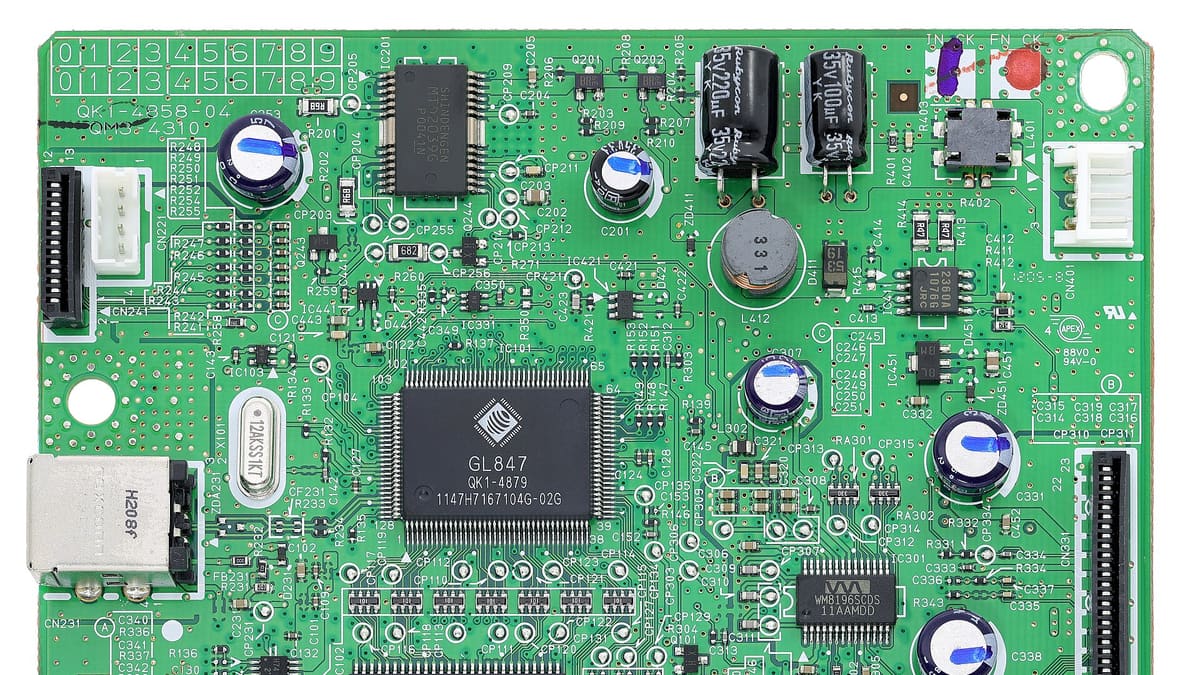
Electronics manufacturing combines thousands of tiny components, fast-moving production and demanding customers. A single wrong reel loaded on a pick-and-place machine can affect hundreds of boards. A field failure can trigger questions about which component lot was used in which serial number. And margins depend on controlling scrap, rework and component wastage precisely. Spreadsheets and paper travellers struggle with all of this.
This guide looks at the software capabilities that matter most for electronics manufacturers, EMS providers and PCB assembly units — from component receipt to field returns.
The electronics manufacturing flow
A typical flow runs: component receipt and inspection → kitting → SMT (solder paste printing, pick-and-place, reflow) → AOI → through-hole assembly and wave or hand soldering → in-circuit or functional testing → box build and final assembly → burn-in where needed → final inspection → packing and dispatch. Each step has its own data, failure modes and quality checks.
Component and reel control
Components arrive on reels, trays and tubes, each with a manufacturer part number, lot or date code and quantity. Software should label each package on receipt with an internal ID, record the supplier lot and date code, and track remaining quantity as reels are used and partially returned. Moisture-sensitive devices need exposure time tracking. Approved alternate parts — common in electronics — must be defined in the BOM so that substitutions are controlled rather than improvised.
Kitting against the BOM
Before a job starts, components are kitted against the BOM. Scanning each reel or package into the kit verifies the right part and records which lots went to which job. Shortages are flagged before the line is set up, not halfway through a run.
SMT line tracking
On SMT lines, the key questions are: which job is running, how many boards have passed each stage, what the first-pass yield is at AOI, and how long changeovers take. Operator booking on a line tablet — or machine data where equipment exposes it — gives live line status. Feeder set-up verification by scanning reels against the feeder list reduces wrong-part placement, one of the costliest SMT errors.
Serial-level genealogy
For many electronics products, the serial number is the unit of traceability. Software assigns or captures a serial at the first relevant step and links to it every component lot kitted for the job, every operation completed, every test result and every repair. When a field return comes in, the full build history is one search away — including which other serials share the same suspect component lot.
Test data capture
In-circuit tests, functional tests and burn-in generate valuable data. Capturing pass/fail and key readings against each serial — imported from test stations where possible, or entered by operators — supports yield analysis, reveals drifting parameters and provides evidence for customers. Failed units move into a repair loop rather than disappearing into a rework bin.
Rework and repair loops
A failed unit is diagnosed, repaired (often replacing a component), retested and returned to the flow. Software should record the defect found, the component replaced, the technician and the retest result. Over time, this data shows which components, processes or suppliers cause most failures — exactly what process engineers need.
Quality management
Incoming inspection of components and PCBs, in-process checks, AOI defect categories, final inspection and NCRs all belong in one quality system. Defect Paretos by process step and product, combined with supplier quality ratings, focus improvement where it matters. See quality management software.
Engineering changes and BOM revisions
Electronics BOMs change often — component obsolescence, cost reductions, customer-requested changes. Revision control with effectivity, and impact analysis showing affected stock and open orders, prevents building to an old revision. See engineering change management.
RMA and field returns
Returned units are logged against their serial, diagnosed, repaired or replaced, and the failure linked to the original build record. Analysis of returns by failure mode, component and build period helps prevent repeat problems and supports warranty discussions with component suppliers.
EMS-specific needs
Contract manufacturers build for many customers. They need customer-specific BOMs and part numbers, consigned versus purchased material, customer-specific labels and documentation, and costing per customer order. Clear separation of each customer's data is essential.
Where to start
- Component labelling at receipt and kitting by scan.
- Serial labels and operation booking on one product line.
- Test result capture and repair loop.
- Quality analytics, engineering changes and RMA.
Corposol builds electronics manufacturing software — MES, traceability and quality built around your products and lines. Talk to us about a pilot line.
KPIs electronics manufacturers should track
- First-pass yield at AOI, ICT and functional test.
- Defects per million opportunities for SMT.
- Line changeover time by product family.
- Component attrition versus standard allowance.
- Field return rate by product and build period.
Frequently asked questions
Can the software track every serial number we build?
Yes. Each board or product gets a serial label at the first relevant step, and every operation, component lot, test result and repair is recorded against it.
Can test station results be imported automatically?
If your test stations write results to files or a database, we can import them. Otherwise operators record pass/fail and readings on a tablet against the serial number.
Can it handle customer-supplied components?
Yes. Consigned material can be kept separate from your own stock, with consumption reported per customer order.
Do you support low-volume, high-mix production?
Yes. Many electronics SMEs build hundreds of different assemblies in small lots; routing, BOM and traceability are handled per job.
Can feeder set-ups be verified by scanning?
Yes. Scanning each reel against the feeder list before a run confirms the right part is loaded in the right position.


