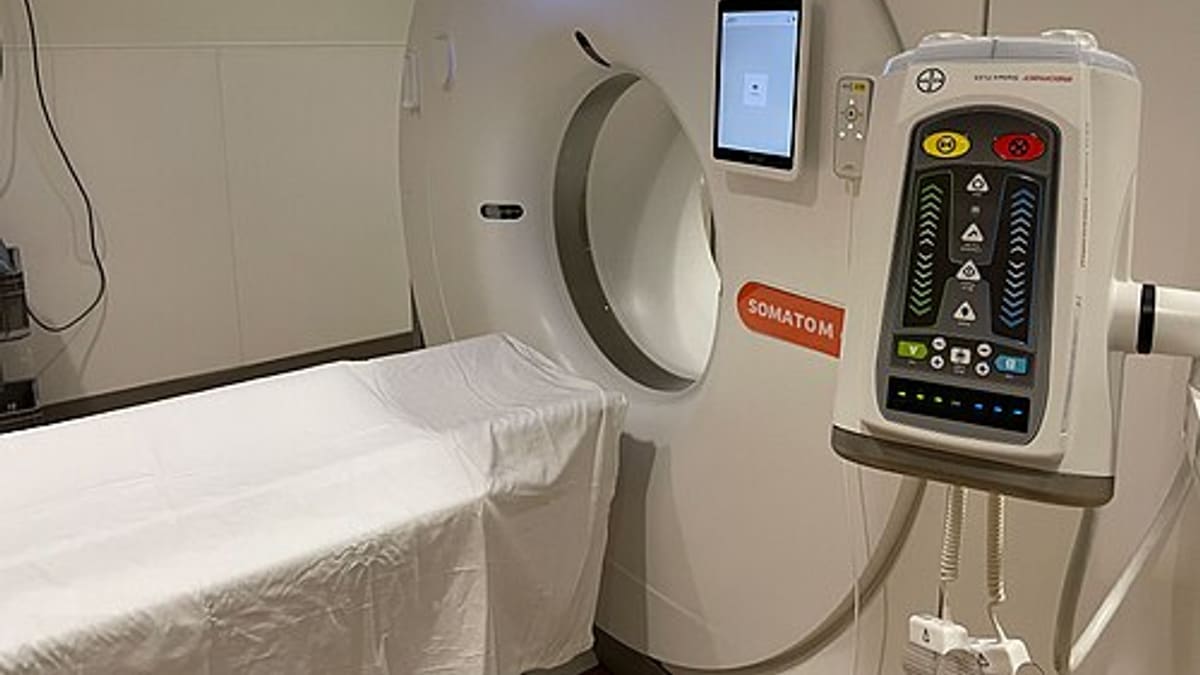
Diagnostic and imaging equipment — X-ray, CT, MRI, mammography, ultrasound, laboratory analysers and patient monitoring systems — is expensive and central to patient care. When a CT scanner goes down, patients are rescheduled or transferred and the hospital loses significant revenue. Service companies, whether manufacturers' service arms or independent providers, often commit to uptime levels in their contracts. Meeting those commitments requires disciplined preventive maintenance, fast fault response, parts logistics and accurate records.
The installed-base register
Each system is recorded with hospital, department, make, model, serial number, software version, installation date, warranty and contract. Major components — tubes, detectors, coils, probes — can be recorded separately with their own serial numbers and histories.
Uptime and contract commitments
Many contracts guarantee uptime percentages. The software records downtime from the moment a fault is reported to restoration, excluding agreed planned maintenance, and calculates uptime per system. Contract performance is visible in real time, helping service managers prioritise and providing evidence for customers.
Preventive maintenance
PM schedules follow manufacturer intervals and contract terms. Checklists cover mechanical, electrical, cooling and image quality checks. PM is coordinated with hospital schedules to minimise disruption, and completion is reported to customers.
Safety and quality checks
Electrical safety tests, radiation-related checks and image quality tests may be required depending on equipment and location. Recording results and attaching reports keeps documentation organised for hospitals. Regulatory compliance remains the equipment owner's responsibility.
Fault management
Faults are logged with symptoms, error codes and priority. Remote diagnosis — where systems support it — is recorded alongside on-site visits. Engineers see system history and recent changes before arriving. Root causes and parts used build knowledge across the installed base.
Parts logistics
Imaging parts can be large, expensive and sometimes imported. Tracking parts by serial number from warehouse to site, recording defective parts returned and monitoring lead times helps reduce downtime and supports warranty and repair processes with suppliers.
Engineer skills and certifications
Different modalities need trained engineers. Recording skills and training per engineer ensures the right engineer is dispatched, and highlights training needs as the installed base grows.
Customer communication
Hospital biomedical and radiology teams want status updates: engineer assigned, diagnosis, parts ordered, expected restoration. Automated updates and a portal reduce calls and build trust.
Laboratory analysers
Lab analysers have their own needs — reagent-related issues, calibration and quality control support, frequent consumable parts. They follow the same principles of registers, PM, fault management and uptime tracking.
A practical rollout
Start with the installed base and contracts, then fault management with downtime tracking, PM scheduling and parts logistics, followed by customer portals and uptime reporting.
Common problems this software solves
- Uptime disputes without reliable downtime data.
- PM missed or delayed.
- Parts lost in logistics.
- Wrong engineer dispatched for a modality.
- Hospitals chasing status updates.
KPIs to track
- Uptime per system versus contract.
- Response and restoration time.
- PM completion on schedule.
- Repeat faults per system.
- Parts lead time.
Corposol builds diagnostic equipment service software. Talk to us.
Remote service and diagnostics
Many modern imaging systems support remote connections for diagnostics, log review and software support. Recording remote sessions alongside on-site visits — with what was checked, findings and actions — gives a complete service history and shows how much downtime remote support avoided. Where remote access requires approvals from the hospital's IT team, those approvals can be recorded with each session.
Planned downtime and hospital schedules
PM on imaging systems means the modality is unavailable for patients. Coordinating PM windows with radiology schedules, recording agreed windows and notifying the department in advance prevents conflicts. Uptime calculations can exclude agreed planned downtime, keeping contract reporting fair to both sides.
Independent service organisations
Independent service providers compete with manufacturers on cost and responsiveness. Strong records — uptime, response times, PM compliance, parts lead times — are their best sales tool when bidding for or renewing hospital contracts.
Frequently asked questions
Can uptime commitments be tracked per system?
Yes. Downtime is recorded per system from fault report to restoration, and uptime is calculated against contract commitments for each customer.
Can preventive maintenance follow manufacturer intervals?
Yes. PM schedules and checklists are defined per model, and completion is tracked against contract requirements.
Can safety and quality checks be recorded?
Yes. Electrical safety tests, image quality checks and other required tests can be recorded with results and attachments. Regulatory compliance remains with the equipment owner.
Can high-value parts be tracked?
Yes. Parts such as tubes, detectors, probes and boards are tracked by serial number from stock to installation and return.
Can engineers access service documentation in the field?
Yes. Manuals and service notes can be attached to models and opened on the engineer's app.
Can hospitals view their equipment status?
Yes, through a portal or reports showing open tickets, PM status and uptime.
Can remote diagnostic sessions be logged?
Yes. Remote sessions are recorded with findings and actions alongside on-site visits, giving a complete service history and showing downtime avoided.
Can planned PM windows be excluded from uptime?
Yes. Agreed planned downtime windows are recorded and excluded from uptime calculations, keeping contract reporting fair.
Can engineer training by modality be recorded?
Yes. Training and authorisations per engineer and modality are recorded, so only qualified engineers are dispatched to each system.
Can defective parts returns be tracked?
Yes. Defective parts removed from systems are tracked by serial number until returned to the supplier or repair centre, supporting warranty and exchange processes.
Can laboratory analysers be managed alongside imaging systems?
Yes. Analysers have their own models, PM checklists and consumable parts within the same installed base, so one team can manage both.
Can hospitals receive automatic status updates?
Yes. Updates such as engineer assigned, diagnosis complete, parts ordered and system restored are sent to the hospital contacts automatically.